Macron government deploys 70,000 officers for second national student march
Thousands marched in Paris and other cities on Saturday under strict route restrictions, a week after riots left over 2,000 people in custody.
By Maya Bauer ·
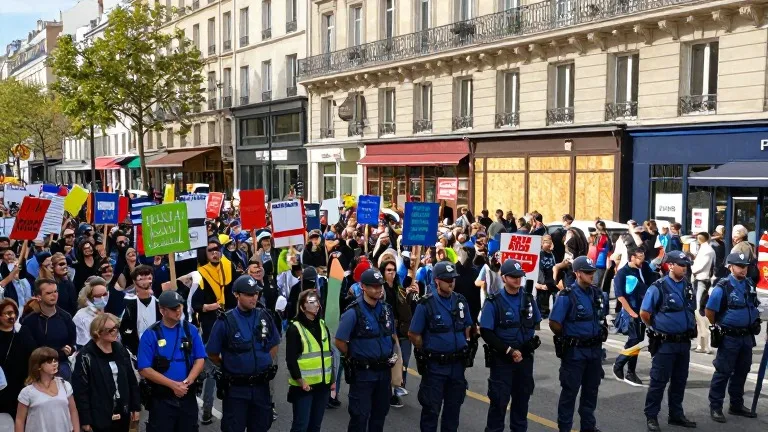
More than 70,000 police officers and gendarmes were deployed across France on Saturday for the second major wave of nationwide demonstrations.
Interior Minister Laurent Nunez stated that this deployment represents a 20 percent increase in security personnel compared to the previous weekend. The government aimed to prevent a repeat of the October 17 unrest, which saw widespread looting and over 2,000 arrests despite largely peaceful initial marches.
In Paris, thousands of marchers gathered at Porte d'Italie to protest school conditions and the cost of living. Authorities permitted the group to march only along the Boulevards des Marechaux to Porte de Vincennes. This route replaced a previously agreed path through the city center that was banned on short notice. Protests organized by non-union groups were also prohibited.
Participants, including students, teachers, nurses, and union representatives, chanted slogans and danced along the designated route. Some groups called for President Emmanuel Macron to resign. One crowd shouted, "Too many billionaires; We are preparing the revolution." Another group chanted, "We are all anti-fascists."
The restricted route drew criticism from marchers. Emma, a podcaster, described the change as a tactic to drain energy from the movement. Monica, a retired public educator, said the decision made the movement appear invisible to authorities.
City infrastructure was adjusted to accommodate the crowds. At least 24 metro stations in central Paris closed at the request of the police prefecture. The Louvre and the Musee d'Orsay museums shut for the day, and Art Basel Paris canceled its weekend events. Many businesses in central Paris covered their windows with protective panels or hired private security.
Protests occurred in other major cities under varying conditions. In Lyon, police used tear gas to disperse approximately 150 demonstrators. In Marseille, a union march proceeded under strict authorization. Protests were banned in the downtown areas of Montpellier, Rouen, and Nice. By early Saturday afternoon, police reported 135 arrests nationwide and the seizure of various weapons, describing the overall situation as calm.