Newman proposes expanding Oct. 7 observances beyond memorial services
The former chair of the Jewish Federation of Greater Philadelphia argues that American Jewish communities should use the third anniversary to drive year-round engagement and public visibility, not just mourning.
By Maya Bauer ·
Bud Newman, former board chair of the Jewish Federation of Greater Philadelphia, has called for a structural shift in how American Jewish communities observe October 7. In a published essay, Newman argued that the date should serve as a catalyst for communal participation and cultural renewal, rather than functioning solely as an annual day of grief. He stated that the community must demonstrate active engagement with its shared history and values to prevent Jewish identity from becoming defined only by reaction to external threats.
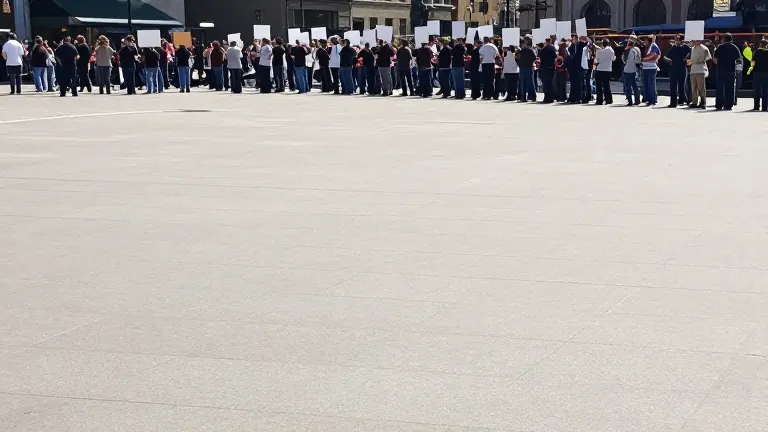
Newman’s proposal follows his personal observations from the third anniversary of the attacks, which took place on October 7 of this year. He stood in Rittenhouse Square in Philadelphia during a pro-Palestinian rally and noted a stark contrast in attendance. While hundreds of demonstrators gathered to support the Palestinian cause, a much smaller group of Jews and supporters of Israel stood nearby honoring the victims. Newman described being vastly outnumbered and identified the absence of many community members as a more pressing issue than the size of the opposing crowd.
The anniversary marked three years since the Hamas-led assault on Israel, which Newman characterized as the worst massacre of Jews since the Holocaust. In the wake of the attack, American Jews have witnessed a rise in visible antisemitism in public spaces and on college campuses. Newman acknowledged that communal institutions have responded with standard measures, including statements, vigils, and security briefings. However, he contended that these traditional institutional responses, while necessary, are insufficient on their own to sustain communal strength.
Newman suggested that communities reframe the anniversary as a day of solidarity that includes learning, service, and cultural celebration. He envisioned thousands of Jews gathering publicly across the United States, including synagogues, day schools, JCCs, and youth organizations. He proposed that these events should include activities designed to connect Jews who rarely participate in organized Jewish life, such as conversations about Israel and volunteer opportunities. He emphasized that such gatherings do not require political or religious uniformity, noting that Jewish peoplehood has historically depended on shared responsibility rather than unanimity.
The former Federation chair pointed to the long-standing debate over declining affiliation within the Jewish community. He argued that October 7 is one of the few experiences that transcends denominational, political, and generational differences. By treating the date as an opportunity for communal participation rather than just a memorial, communities can provide a meaningful entry point for disconnected families and young people. Newman stated that success should be measured by how many previously disengaged individuals become involved and how many new relationships are formed, rather than by attendance numbers alone.
Newman emphasized that the community must avoid allowing adversaries to determine when and how Jews show up in public. He argued that Jewish identity must be embraced based on belief and purpose, not just fear. He suggested that children should see confidence and pride alongside resilience. For communal institutions, the challenge is to build something enduring that strengthens connections throughout the year, not just during the annual event.
Newman concluded by stating that the community faces a choice between continuing to commemorate the date primarily through reflection or using it to ensure Jewish life becomes stronger and more visible. He noted that these two approaches are not mutually exclusive. He expressed hope that next year, communities will remember with the same solemnity but gather with a broader purpose to demonstrate how Jews intend to live.
Newman is the former board chair of the Jewish Federation of Greater Philadelphia. He wrote the essay for The Jewish Exponent, reflecting on the events of the third anniversary and the state of communal engagement in the region.