Texas Rail: Austin and San Antonio Leaders Push for High-Speed Connection
Two city council members are urging a new look at passenger rail between Central Texas hubs, citing a $13.5 billion feasibility study and a state bill that could extend the line to Dallas.
By Bianca Ruiz ·
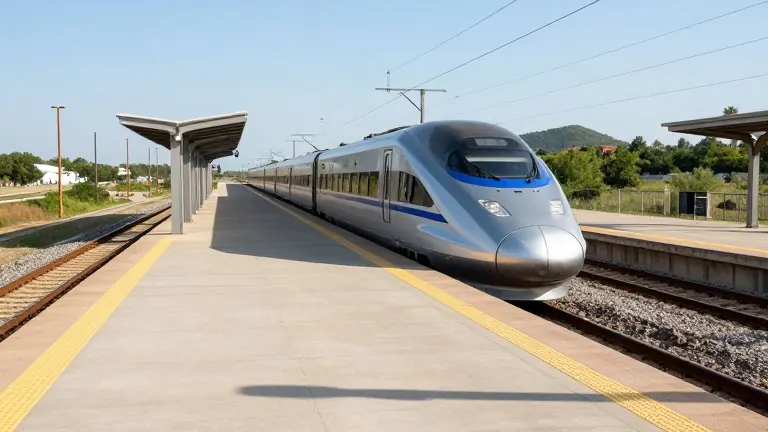
Austin and San Antonio city council members are urging state leaders to pursue a high-speed rail line connecting the two cities, arguing that the arrival of new statewide officials creates an opening for the project. Vanessa Fuentes of the Austin City Council and Jalen McKee-Rodriguez of the San Antonio City Council released a joint video supporting the initiative, referencing recent feasibility studies that outline two potential routes between the Texas Hill Country’s largest metropolitan areas.
The studies identify a cost of approximately $13.5 billion for construction, with annual operations and maintenance expenses estimated between $140 million and $190 million. Trains would reach speeds of up to 125 miles per hour, reducing travel time between Austin and San Antonio to between one hour and an hour and a half. The documents note that congestion on Interstate 35 continues to drive demand for alternative passenger transport options between the two hubs.
One proposed route would run along State Highway 130 before connecting to Interstate 10 in San Antonio. This path would begin at Austin-Bergstrom International Airport and terminate at one of four potential locations in San Antonio. A second option follows the Interstate 35 corridor, with stops in San Marcos and New Braunfels. This route could utilize existing Union Pacific Railroad infrastructure, though officials say an agreement with the private railroad company would be required to integrate those assets.
State Rep. John Bucy, a Democrat representing Austin, has filed House Bill 270 for the 90th Texas Legislature. The bill would direct the Texas Department of Transportation to negotiate a public-private partnership to build, maintain, and operate a high-speed rail line linking Dallas, Waco, Austin, and San Antonio along the Interstate 35 corridor. The legislation defines high-speed rail as intercity passenger service capable of reaching at least 110 miles per hour, though it does not secure funding or guarantee construction.
Bucy said the project would allow rapid movement along the corridor, benefiting business and economics. McKee-Rodriguez told FOX 7 that the new state leadership presents an opportunity to advance the project. He noted that funding remains the primary hurdle, pointing to three options in the feasibility study: federal grants, local funding contributions, or a privately owned operating company.
The federal government previously awarded Amtrak nearly $64 million in 2023 to plan a Texas high-speed rail project, but that grant was terminated in 2025. Then-Transportation Secretary Sean Duffy described the project as a waste of taxpayer funds and a distraction from Amtrak’s core mission. Next steps for the current initiative include coordinating with TxDOT, conducting ridership and environmental analyses, and developing a funding strategy.