UK Government Orders Households to Store 72 Hours of Emergency Provisions
The directive targets a wide range of threats, from Russian state-sponsored terrorism to climate-driven infrastructure failures, prompting a nationwide shift in shopping habits.
By Bianca Ruiz ·
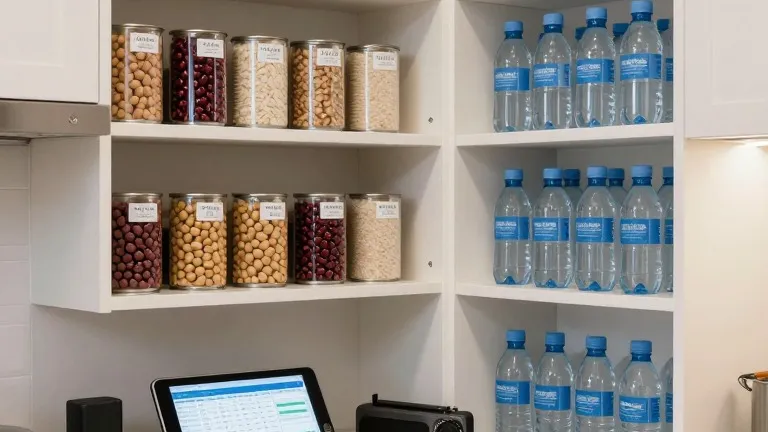
The UK government launched a campaign on Thursday urging residents to secure three days' worth of emergency supplies. The directive instructs households to stockpile enough food, water, and essential items to survive without external support for 72 hours. This recommendation follows months of official signals warning about the escalating risks posed by Russian state-sponsored terrorism and the compounding effects of the climate crisis.
The push for preparedness has accelerated household buying patterns across the country. While the formal campaign began this week, many families had already started building reserves in response to earlier ministerial warnings. The new guidance aims to standardize these efforts, providing a clear benchmark for what constitutes an adequate emergency kit.
Lawrence Barratt of Hythe, Hampshire, began his stockpile roughly two weeks ago after reviewing government advice online. He is now adding tinned goods, dried pasta, rice, and bottled water to his weekly grocery runs. His goal is to maintain a three-day supply for two people, including a first aid kit, a battery-powered FM radio, and a torch. Barratt also relies on a portable power bank he previously used for camping, which he believes can charge phones, run a television, and power a small fan heater. He stated that the government's Be Ready campaign website made him realize he "would be completely unprepared for anything."
In Greenwich, London, Marco Camurri has been preparing his household for several months. His family began collecting pasta, stock cubes, medicines, and toilet paper after reports of supply chain disruptions linked to the El Niño weather pattern emerged. Camurri keeps wood in his garden to boil water and maintains a car fuel tank level above 50 percent, ensuring roughly 300 miles of driving range. He and his family track the expiry dates of their stored items in a spreadsheet to ensure they rotate supplies regularly. He noted that his relatives in continental Europe could potentially leave the UK if the country entered a state of war or suffered extreme infrastructure failure.
Jack Davenport of North Shields, Tyne and Wear, also cited El Niño as a primary motivator for his stockpiling efforts. He described the current threat environment as difficult to quantify, pointing to climate disasters, Russian shadow threats, and rising interest rates driven by energy insecurity. Davenport characterized the nation's physical and technological infrastructure as "creaking and outdated." He suggested that the government is attempting to "reduce long-term panic" by framing these emergencies as plausible scenarios for a generation that has not faced widespread hardship since the war.
Not all residents accept the new guidance. Deirdre O'Sullivan of Leicester described the advice as "daft," comparing it to 1970s instructions to hide under a table during nuclear attacks. She argued that the three-day target is inadequate for a genuine emergency, noting that threats to drinking water would require more precise anticipation. O'Sullivan suggested that an extreme food shortage would likely be visible over a much longer period than 72 hours. She likened the policy to a measure "Yes Minister would come up with to demonstrate that they have a policy in place, even if that policy is clearly totally useless."
The campaign website provides specific lists of items for households to prioritize. These include non-perishable foods that can be cooked with stored water, backup power sources, and manual communication devices. The government states that the 72-hour window is designed to cover the initial gap before professional emergency services and supply chains can fully respond to a major disruption.
As the campaign gains traction, retailers are seeing increased demand for the specific items listed in the guidance. Shoppers are adding batteries, power banks, and tinned goods to their carts alongside regular weekly staples. The shift reflects a tangible change in consumer behavior, driven by official warnings that link domestic security to both geopolitical and environmental factors.