Crows Solve Visual Puzzles Twice As Fast As Monkeys
New research reveals that carrion crows use the same decision-making logic as primates despite having a different brain structure.
By Beatrice Gray ·
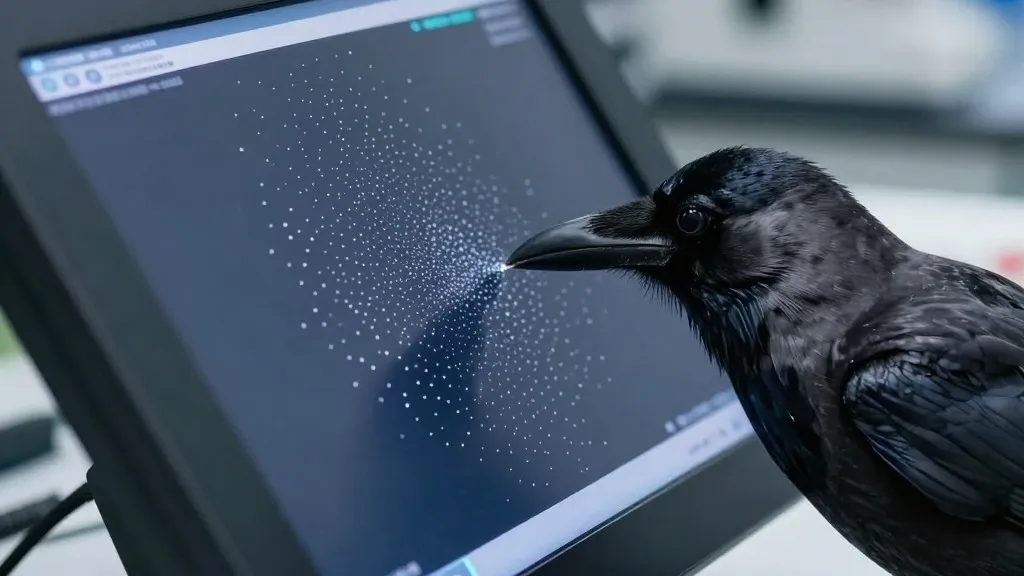
Eighty-one percent of moving dots made the test trivially easy for the birds, yet they solved the hardest versions with precision. A team of neurobiologists recently demonstrated that crows process visual information in a manner strikingly similar to that of primates. However, the birds completed the cognitive tasks at twice the speed of their monkey counterparts. This finding challenges long-held assumptions about how non-primate brains handle complex decision-making processes.
The study relied on a well-established experimental framework known as the random-dot-motion task. In this setup, a cloud of flickering specks drifts weakly in a specific direction. The subject must identify the presence of movement and its orientation. Previous research in primates showed that neurons in the neocortex accumulate visual evidence over time. Their firing rates rise until they cross a specific threshold, prompting the animal to commit to a choice. Birds lack this specific brain region, leaving a gap in scientific understanding.
Andreas Nieder, a neurobiologist at the University of Tübingen, described this gap as the central mystery of the investigation. He noted that the team sought to understand how a differently organized avian brain encodes decisions. To address this, Nieder and colleague Philipp Schmidbauer subjected two hand-raised carrion crows to the same trial. The birds sat before a touch-sensitive monitor displaying white dots against a black background. A portion of these dots drifted together in one of four directions. The crows indicated their choice by pecking a target on the side of the display. A correct response resulted in a mealworm reward.
The researchers ensured the experimental conditions mirrored those used with monkeys as closely as possible. Nieder emphasized that the team wanted the random-dot motion task to be identical across species. The primary distinction lay in the method of response. Monkeys indicated their decisions through eye movements, while the crows used their beaks to peck the appropriate target. This methodological consistency allowed for a direct comparison of cognitive processing speeds and accuracy.
The team adjusted the difficulty of the task by altering the number of dots that moved coherently. At the lower end of the difficulty spectrum, eighty-one percent of the dots moved in unison, making the direction obvious. At the higher end, only three percent of the dots aligned with the overall motion, creating a signal that was barely distinguishable from random noise. The experiment also included a condition where zero percent of the dots moved together, effectively removing any correct answer from the display.
Despite the structural differences in their brains, the crows employed the same mathematical logic as primates to solve the problem. Their neural mechanisms appeared to follow a comparable accumulation process. The key difference was the speed of execution. The birds reached their conclusions in half the time required by monkeys. This result suggests that a brain without a neocortex can still arrive at robust decisions through a parallel processing pathway. The findings offer new insights into the versatility of neural architectures across different animal classes.