Gaza Ministry Records 54,468 Children Without Parents
Three siblings now rotate between aunts' tents every two days, part of a count that includes 3,000 minors with no registered guardian.
By Maya Bauer ·
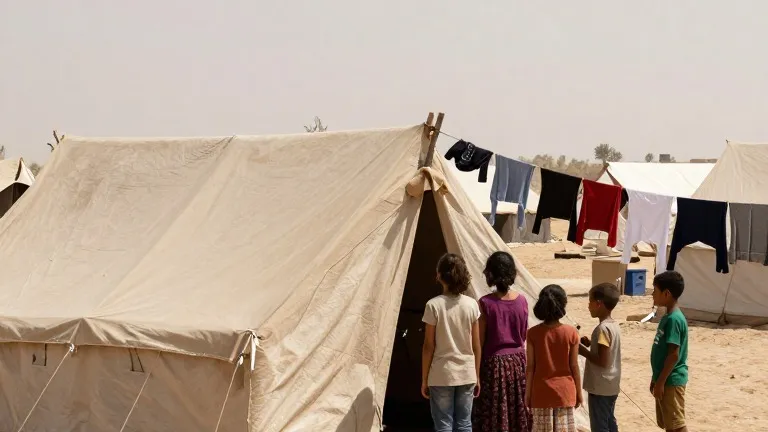
The Abu Asser siblings in Gaza pack their belongings every 48 hours to move from one aunt's tent to another. Mariam, 16, Aya, 14, and Jebril, 12, established this routine after an Israeli airstrike killed their mother, Islam, on the 19th day of the ceasefire that began on October 10, 2025. The strike occurred in a makeshift shelter in Deir al-Balah, central Gaza, where the family had taken refuge after their home in Gaza City was destroyed.
The Palestinian Ministry of Social Development in Gaza reported that the three are part of a total of 54,468 children who have lost one or both parents since October 2023. The ministry's registry also lists at least 64,000 widows and 71,000 orphaned children across the territory. These figures include those bereaved in earlier Israeli military operations. The data further indicates that approximately 3,000 children lack a registered guardian, custodian, or caregiver.
The Abu Asser children had previously lost their father during Israel's 2014 offensive. Their aunt, Warda al-Muzeini, stated that the family has no stable residence. The children primarily stay with their paternal grandmother but rotate between maternal aunts, spending two nights with each. Jebril was sitting in his mother's lap when the bomb hit and sustained injuries. Al-Muzeini said, "He saw his mother die in front of him."
Al-Muzeini lost her husband in an Israeli air strike and now raises four children without a job or reliable income. She reported struggling to provide one meal a day. Another of the aunts is also a widow. The sisters share the financial burden, with one buying pajamas, another purchasing slippers, and a third providing pocket money for a few days.
Aziza al-Kahlout, a spokesperson for the ministry, stated that the raw numbers do not reflect the daily hardship. She noted that a child who loses both parents loses care, safety, education, and childhood, often taking on responsibilities beyond their age. Women who become the sole breadwinners face the dual task of providing for and raising children amid devastation.
Al-Kahlout warned of growing risks of child labor, school dropout, and early marriage in Gaza. She attributed these trends to poverty, displacement, and the loss of family breadwinners. She said orphaned children are particularly vulnerable as economic and humanitarian conditions worsen and adequate shelter remains scarce.
Wafaa al-Attar, now 13, lost her entire family in a single airstrike. On February 22, 2024, she was 10 years old when she left her home in Deir al-Balah to charge her father's phone at her uncle's nearby house, which had solar panels. A blast struck the multi-storey building just as she arrived. "I turned around, and our home was no longer there," she said.
The strike killed her father, Ahmed, her mother, Khouloud, and four siblings: Rital, 8; Muhammed, 5; Obada, 3; and nine-month-old Yazan. Attar suffered minor shrapnel injuries and was taken to a hospital. She asked about her family until her uncle arrived and confirmed their deaths. She remained silent for two to three hours before asking, "All of them at once?"
Attar initially stayed with her grandparents before moving in with her uncle, his wife, and their newborn. She said she wished for months that she had been in the building when it was bombed. Her uncle's wife told her that her father would want her to stay strong. "But of course, I know that no one could ever replace my own family," Attar said.