Lunar Hydrology: Moon Water Caps Cities at 10,000
New analysis indicates current estimates of lunar water reserves sustain a town for centuries, but a million-person metropolis would deplete supplies in a century.
By Maya Bauer ·
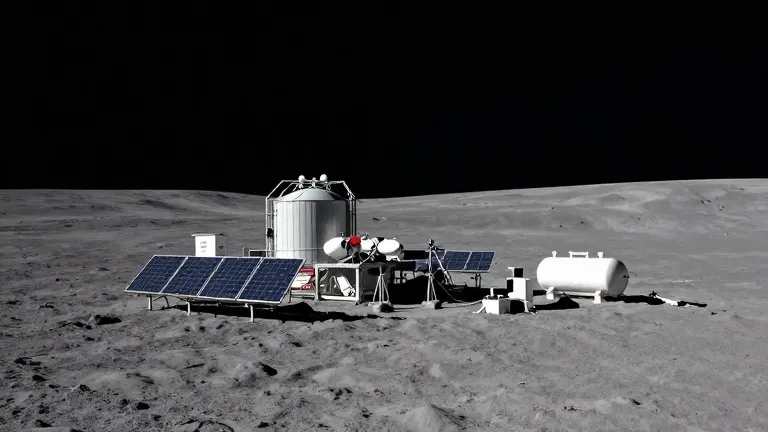
One billion tonnes of water, the current best estimate for lunar reserves, would support a million residents for only about 100 years, according to a new study published in the journal Frontiers in Space Technologies. The figure assumes a 98 percent recycling rate, matching the efficiency achieved on the International Space Station. This capacity falls far short of the sprawling lunar settlements envisioned by major aerospace executives.
In February, SpaceX CEO Elon Musk stated the company is prioritizing a self-growing city on the moon over Mars, with a target timeline of under 10 years. Blue Origin CEO Jeff Bezos has separately projected that millions of people will inhabit space by 2045. These claims prompted Martin Elvis, a senior astrophysicist at Harvard University's Smithsonian Astrophysical Observatory, and Jonathan McDowell, an honorary professor at the Durham University Space Research Centre, to analyze the physical constraints. They focused on two essential resources: power and water.
The researchers determined that power generation is not the limiting factor. Solar and nuclear sources are sufficient to sustain one million people on the lunar surface. The constraint is water, which is believed to reside in permanently shadowed regions at the poles. Elvis described the total available volume as modest. He compared the quantity to an aquarium the size of Central Park filled until the Statue of Liberty is just underwater, noting that a small lake cannot supply a big city for very long.
A settlement of 10,000 people would be sustainable for centuries under the same assumptions. McDowell noted that covering the moon with cities requires finding a way to transport water to the surface, as it is not currently present in accessible quantities. He emphasized that the findings are not discouraging, stating that the truth is never negative and that only actual attempts at infeasible projects are negative.
The study's assumptions may be generous. Elvis suggested the one-billion-tonne figure is likely 20 to 30 times too large. He estimated that only one-third to one-half of the water is recoverable. His best guess is that the countable amount is about one percent of the original figure, which would reduce the 100-year lifespan for a million-person city to one year.
Gordon Osinski, a professor of planetary geology at Western University in London, Ontario, noted uncertainties in satellite measurements. He believes the water exists but requires on-the-ground confirmation. Osinski suggested the water may resemble Arctic permafrost, with sub-millimetre ice crystals mixed into soil that are difficult to extract.
The analysis provides a baseline for lunar settlement planning. The data suggests that while power infrastructure can support large populations, hydrological limits restrict long-term residency to smaller communities unless water extraction methods improve.