Mars Cloud Model Requires 100,000 Times Earth's Humidity
A new simulation links the Arsia Mons cloud to a rare freezing process that demands extreme temperature drops and unseen moisture levels.
By Maya Bauer ·
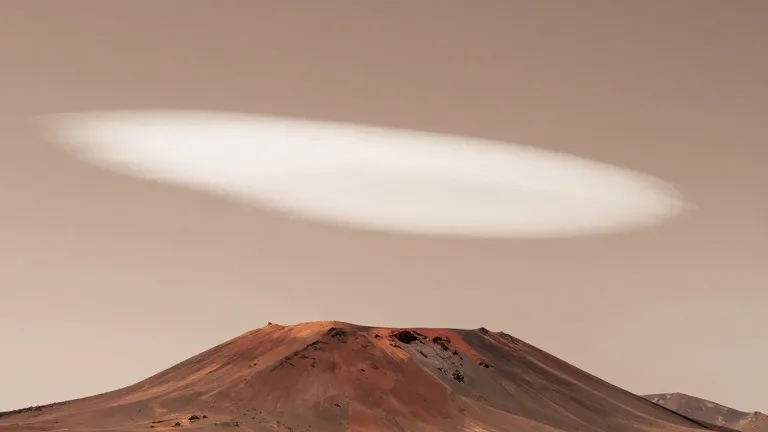
A new modeling study suggests that a massive morning cloud on Mars forms through a physical process never directly observed in any planetary atmosphere. The research, published in Nature Geoscience, successfully reproduces the formation of the Arsia Mons Elongated Cloud, or AMEC, for the first time.
The AMEC stretches more than 1,000 miles, a distance comparable to the straight-line span from New York to Kansas City. It appears during Martian spring and summer, growing longer through the morning before dissipating. A probe first recorded the feature in 2018, but scientists had not previously found a plausible explanation for its existence.
Jorge Hernández-Bernal, a planetary scientist at Sorbonne Université in Paris, led the study. He stated that the simulations only worked after the team included what he called "exotic physics." This mechanism, known as homogeneous nucleation, allows water vapor to turn directly into ice crystals without dust or salt particles to seed the process. Hernández-Bernal described the phenomenon as appearing in textbooks but usually treated as theoretical rather than natural.
The model requires extreme conditions to trigger this nucleation. Specifically, the atmosphere must experience a temperature drop of 30 degrees Celsius within 10 minutes. The 65,000-foot Arsia Mons volcano creates these conditions when wind hits its peak, generating a powerful wave that lifts moist air high into the atmosphere within minutes.
The humidity required for this process is more than 100,000 times greater than any value measured on Earth. Scientists previously assumed such high relative humidity did not exist in the Martian atmosphere. Hernández-Bernal noted that far less is known about Mars' atmosphere compared to Earth's, making the successful reproduction of the cloud a notable achievement.
The team likened the cloud formation to droplets of condensation appearing in the middle of a room rather than on a window. Hernández-Bernal called the result "wholly unexpected" and "remarkable." The study indicates that while similar nucleation might occur in the upper atmospheres of Venus and Earth, it has never been observed there, likely due to lower humidity levels.