Three Meteors from Halley's Comet Captured in Georgia
A photographer in Toccoa recorded three distinct streaks from the Orionid shower on October 21 while the parent comet remained billions of miles away.
By Maya Bauer ·
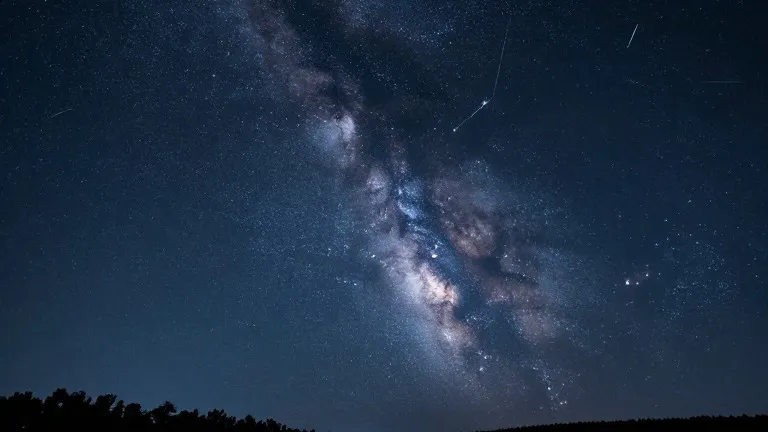
Tim McCollum, an astrophotographer based in Toccoa, Georgia, captured three bright meteors on the night of October 21. The image, taken between 3 a.m. and 4 a.m., documents the annual Orionid meteor shower as it approached its peak activity for the season.
The streaks in the photograph are fragments of Comet 1P/Halley. Despite the comet currently being more than 3 billion miles from Earth, the debris it shed long ago continues to intersect with Earth's orbit. When these particles enter the atmosphere at high speed, they burn up and create the glowing trails seen in the composite image.
McCollum used a Canon EOS Ra camera paired with an RF 28-70 f2.0 lens to record the event. He took multiple 30-second exposures while using a star tracker to keep the camera aimed at the shower's radiant. The radiant is the point in the sky from which the meteors appear to originate, located near the red giant star Betelgeuse in the constellation Orion. He later merged the individual frames into a single composite image using PixInsight software.
The photograph includes other astronomical features beyond the meteor trails. The three stars of Orion's Belt appear on the right side of the frame, positioned near the light of the Orion Nebula. The Rosette Nebula, designated Caldwell 49, is also visible within the image. The diagonal band of the Milky Way's galactic plane, containing numerous star clusters and dust lanes, runs through the background of the shot.
The Orionid shower remains active until November 7. Observers in the coming weeks still have opportunities to see meteors from Halley's Comet with the naked eye or through basic equipment. The shower is not the only source of meteor activity during this period.
Earth is currently passing through debris streams from Comet 2P/Encke. These streams produce the Taurid meteor shower, which can occasionally generate bright objects known as Halloween Fireballs. This secondary shower provides an additional, though less frequent, source of visible meteor activity in the autumn sky.