16 deaths in Novi Sad drive Serbia into tight parliamentary race
Student-led lists challenge long-time leader Aleksandar Vučić in Sunday's vote, with polls indicating a narrow margin between the two camps.
By Bianca Ruiz ·
Serbian voters cast ballots on Sunday in a parliamentary election that analysts predict will result in an extremely close vote. The contest pits Aleksandar Vučić, the country's leader since 2012, against a student-driven movement that emerged from nearly two years of anti-corruption protests. Reliable polling data is limited, but the outcome is expected to hinge on the fallout from a specific infrastructure failure in the country's second city.
The Student List formed after 16 people died when a canopy collapsed at a railway station in Novi Sad. Instead of selecting a single nominee, student assemblies at various university faculties chose 250 candidates. Ilija Srdanović, a cardiologist and professor at Novi Sad University, heads the ballot. He is not the movement's leader, nor is he guaranteed to become prime minister if the list wins. The other candidates include academics, athletes, and engineers, none of whom have prior political experience. A student at Novi Sad University, who went by the name Aleksandra, stated, "We've gathered people who are actually the best in their fields."
Vučić has held positions as deputy prime minister, prime minister, and president since 2012. He stepped down as president last month to run for prime minister in the snap election he called. He maintains support from voters who view him as a strong defender of national interests. He cites economic growth and infrastructure improvements over the last decade as key achievements. Conversely, he has described the student movement as foreign-backed and intent on bringing down the state. The Student List argues that Vučić and his Serbian Progressive Party dominate state institutions and media. An International Election Observation Mission noted in 2023 that media bias and the misuse of public resources gave the ruling party an overwhelming advantage.
The Novi Sad disaster complicates Vučić's position because the station renovation was part of his flagship high-speed rail project connecting Belgrade and Budapest. Magda Anastasijevic, an Eastern Europe analyst at the conflict monitor ACLED, observed that Vučić usually survives crises by finding a scapegoat. She noted, "This was not the case for the canopy." Foreign policy also entered the campaign, as Vučić warned that close ties with Russia and China could be lost under a Student List government. He asked at a rally whether the group would impose sanctions on Russia.
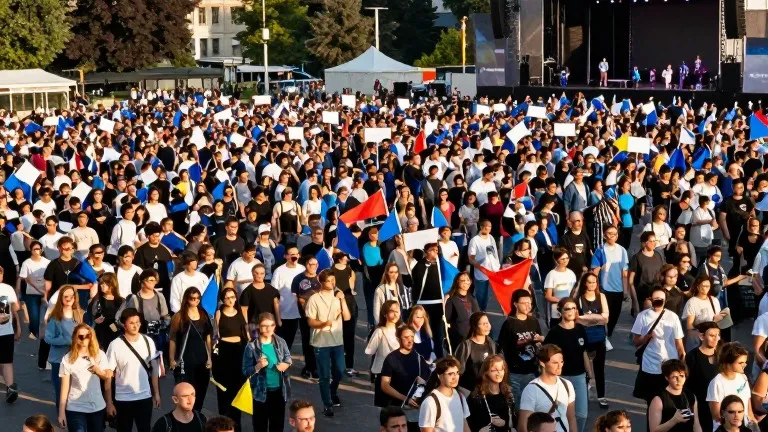
The final days of the campaign showed a sharp contrast in strategy. The ruling party filled Belgrade Arena with Vučić as the sole speaker. In contrast, a reported 150,000 people gathered in Slavija Square to hear students and candidates. A pro-government camp has occupied a small park in central Belgrade for 18 months, and its residents have repeatedly attacked journalists. Vučić has called the camp a symbol of resistance. The BBC approached leading party figures for comment but received no response.
Voters will decide between a single strong leader and a collective approach. The Student List has no hierarchy, and Srdanović arrived for an interview on a motorbike wearing a fluorescent yellow jacket with pro-student slogans. He said it was normal to stand with his students to help them in their fair struggle.
More Politics · World news · Report a business · Got a Story?