Payment Kiosks Force Travelers to Tip Before Service Is Rendered
Experts and consumers report that digital screens increasingly default to high gratuity percentages, pressuring users to pay before a worker has provided any assistance.
By Bianca Ruiz ·
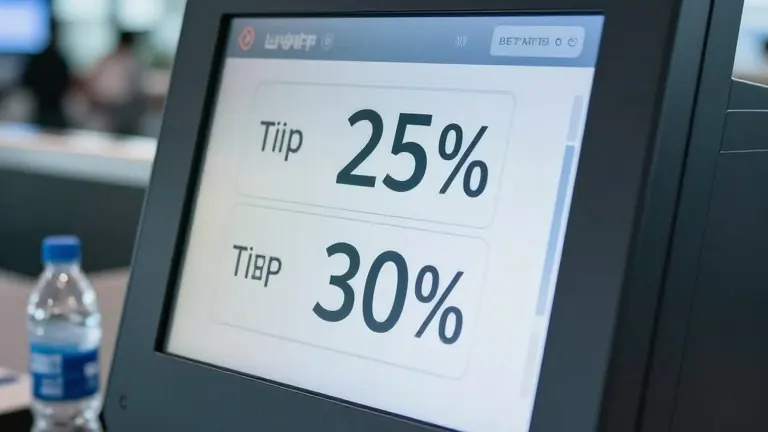
Digital payment terminals at airports, hotels, and ride-hailing services now display high tip percentages before a customer receives any service. Cara Laban recently purchased a seven dollar bottle of water from a kiosk near an airport gate, and the screen immediately asked if she wanted to leave a 25 percent or 30 percent tip. Laban, the founder of an online travel preparation tool and a former restaurant server, noted that she usually tips but found the prompt excessive for a self-service transaction.
Consumer sentiment has shifted in response to these automated prompts. More than two in five Americans believe the United States should ban tipping, and 81 percent say the practice has gotten out of control, according to recent data. Chip Lupo, a WalletHub analyst, stated that aggressive tipping prompts are becoming a growing source of frustration in travel and hospitality. He said this concern reflects a wider shift in how tipping is being used and perceived by consumers.
Businesses use screen design strategies to maximize revenue, often prefilling high percentages before a worker performs any task. Faiz Ahmed, an expert on payment infrastructure, explained that terminal makers know exactly what conversion lift each layout produces. He noted that buttons are getting larger, percentages are climbing, and the no tip option is moving to less prominent positions on the screen. This design pressure appears in hotel check-ins, ride-hailing cars, and self-service machines where no human interaction occurs.
Andrew Cullison, executive director of the Cincinnati Ethics Center and a philosophy professor at the University of Cincinnati, raised moral objections to pre-loaded tip prompts. He argued that tipping was designed to reward service after it has been rendered. Cullison said that asking for a tip before anyone touches the bread at a deli works against the reward and incentive functions of the practice. He also identified the social pressure of a public screen with a line behind the customer as a form of coercion.
The practice of guilt tipping can erode trust in the system. When travelers decline tips across the board due to bad prompts, wait staff at sit-down restaurants who depend on gratuities may suffer. Cullison said these prompts are designed to make declining feel antisocial. He suggested that recognizing this design is useful for consumers deciding whether to pay.
India’s Ministry of Road Transport and Highways ordered ride-hailing apps to delete tip prompts that appear before or during a trip this summer. Under the country’s Motor Vehicle Aggregator Guidelines, an app can offer a tip button only after the ride ends. The regulation also requires that the driver receives the full amount of the tip, with no cut for the platform. The ministry reportedly reacted to apps that offered advance tips or hinted that a tip might speed up the process.
Experts recommend that consumers slow down and read the screen to choose an amount that matches the service actually provided. Justin Carter, an assistant professor of management at the University of North Alabama, said the villains in these situations are poor design and lack of transparency. Gregory Lee, chief operating officer for an apartment rental site in Boston, suggested asking if a specific human did something tangible. If the answer is no, he said a customer can decline without feeling cheap. Laban carries small bills to tip workers directly when she is unsure the platform payment reaches them.