NASA to Burn Three Heavy-Lift Rockets to Test Moon Lander Systems in Orbit
The 14-day mission will validate hardware for two competing landers before a planned 2028 lunar landing.
By Beatrice Gray ·
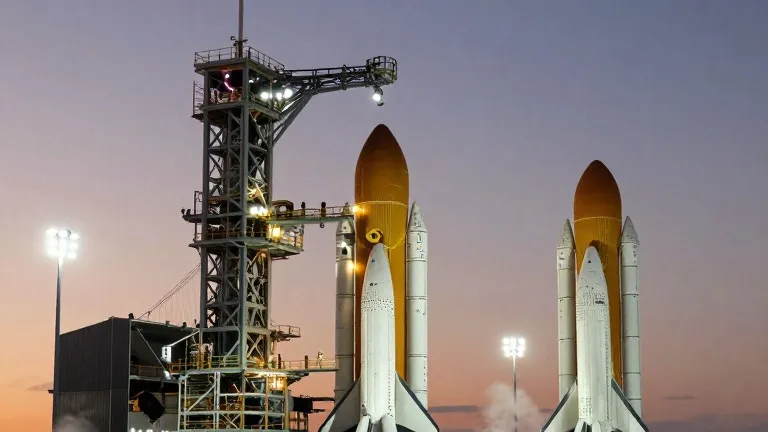
NASA will spend three heavy-lift rockets to test two rival moon landers in Earth orbit. The agency detailed the complex launch campaign on Oct. 23 at Kennedy Space Center. The mission, designated Artemis III, is designed to prove out commercial landers before astronauts attempt a lunar touchdown.
Artemis program manager Jeremy Parsons called the sequence "likely the most complicated launch campaign ever undertaken." The plan involves NASA's Space Launch System, SpaceX's Starship, and Blue Origin's New Glenn. All three vehicles will launch from Florida's Space Coast.
The sequence begins with New Glenn carrying Blue Origin's Blue Moon lander into low Earth orbit. SLS follows with four astronauts aboard the Orion capsule: Randy Bresnik, Andre Douglas, and Frank Rubio from NASA, and Luca Parmitano from the European Space Agency. SLS will place Orion in a highly elliptical orbit with an apogee of 1,122 miles (1,806 km). Orion will then adjust its orbit to approximately 345 miles (555 km) to manage thermal stress.
The crew will spend two days checking Orion systems before docking with Blue Moon on Flight Day 3 at an altitude of 273 miles (439 km). During two docked days, the astronauts will enter the lander to evaluate environmental controls and life support. They will also test emergency scenarios and verify that the spacecraft holds proper atmospheric pressure. Mission Control will run through operational procedures during this phase.
Starship will launch around Flight Day 6 with a specially built docking adapter on its nose. The 171-foot (52-meter) upper stage is expected to meet Orion on Flight Day 8 at about 237 miles (381 km). This encounter will last roughly two hours. The crew will not enter Starship but will collect data on docking forces and how the vehicles interact.
After undocking from Starship, the mission continues for six to nine more days. The nominal mission length is 14 days, though it could reach 17. The crew will evaluate survival suits, a task not completed during the 10-day Artemis II flyby in April. They will also conduct health assessments and technology demonstrations before a parachute-aided ocean splashdown.
The results will prepare for Artemis IV, planned for 2028 near the moon's south pole. This would be the first crewed lunar landing since Apollo 17 in 1972. NASA has not selected a lander provider for that mission. Administrator Jared Isaacman stated the agency is preserving options for both partners. "We have no intention of surrendering a viable path to the surface before the data and schedule compels us to do so," Isaacman said. Parsons noted that both providers are targeting 2028 lunar missions. The launch date for Artemis III is unclear, with NASA targeting next summer. Isaacman told employees last month that the mission was about 90 days behind schedule. Parsons cited the lunar lander supply chain as a major challenge but expressed confidence in the timeline.