US institute reports new underground site built at speed between Isfahan and Pickaxe Mountain
Satellite imagery shows rapid construction of a buried facility as Iranian drones kill two Italians in Kuwait and Houthis strike a Saudi refinery.
By Maya Bauer ·
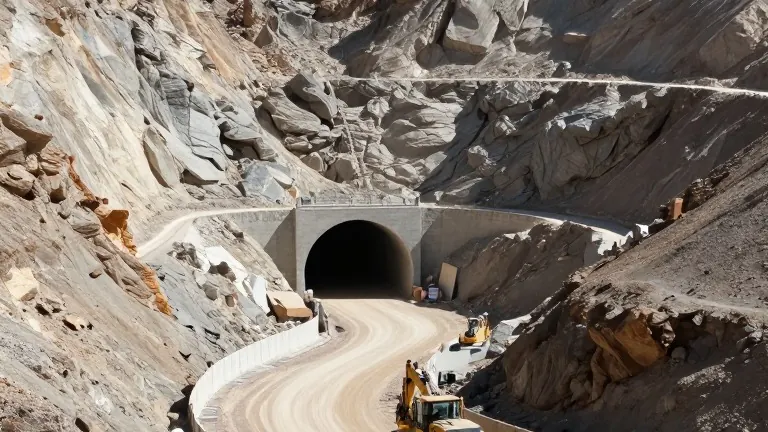
The Institute for Science and International Security reported on Thursday that Iran is rapidly constructing a new underground facility located exactly midway between the Pickaxe Mountain and Isfahan nuclear sites. The research group, based in the United States, released the findings alongside satellite imagery provided by Vantor Technologies. The institute described the construction speed as unusual, noting that the project moved quickly from initial signs to visible infrastructure.
According to the report, the first indicators of the site appeared in mid-December 2025. By January 2026, a new road was visible leading toward a tunnel system. In June 2026, imagery revealed signs of a second tunnel emerging. The institute stated that the function of the facility is not yet clear, though it added that a nuclear purpose cannot be ruled out. Iran has also begun building a security barrier around the outer perimeter of the site.
The discovery comes as the regional conflict continues to expand across the Gulf. An Iranian drone strike in Kuwait killed two Italian technicians on Thursday. Antonio Tajani, Italy's foreign minister, told the Senate that the victims were working for the Italian unit of German defense group Rheinmetall. He said the two technicians were at an air-defense surveillance station when the attack occurred. A Pakistani national and a Kuwaiti army captain were also injured in the blast.
Kuwait's Defense Ministry confirmed the deaths and reported that the attack caused material damage to a key facility. The ministry said its military detected and engaged several drones in the airspace. Iranian state media reported that armed forces spokesperson Abolfazl Shekarchi denied responsibility, claiming no offensive operations were conducted in the area. Italian Prime Minister Giorgia Meloni offered condolences on social media, while European Commission President Ursula von der Leyen called for increased pressure on Tehran.
In Yemen, the Iran-backed Houthis attacked Saudi Aramco's Jazan refinery on Thursday. The facility, located in the southwestern city of Jazan near the Yemeni border, is designed to process up to 400,000 barrels of crude oil per day. The Saudi-led military coalition said it destroyed a ballistic missile launch platform in the Yemeni port city of Hodeidah in response to the attack. This strike followed Houthi claims of attacks on Ras Tanura, the kingdom's largest refinery, and the Red Sea ports of Jeddah and Jazan on Wednesday.
Diplomatic efforts continue amid the fighting. Abbas Araghchi, Iran's foreign minister, said in a video on Telegram that Qatari and Pakistani mediators are transmitting ideas between Iran and the United States. He stated that Iran has specific requests that must be met before the Strait of Hormuz can be reopened. The Iranian Revolutionary Guards reported that two tankers exploded and caught fire after hitting sea mines north of Oman's Khasab port while attempting to cross the strait through an unauthorized route.
One of the vessels was a supertanker carrying more than 2 million barrels of crude oil, the Guards said in a statement. Rear Admiral Ali Azmaei, the commander of the Revolutionary Guards Navy, asserted that Iran has full operational control of the Strait of Hormuz. He said safe passage depends on respect for Iran's sovereign rights. The UK Maritime Trade Operations agency separately reported an explosion near a tanker about 50 nautical miles west of Dubai caused by an unknown projectile.
Inside Iran, Supreme Leader Mojtaba Khamenei issued a written statement marking Basij Week. He called on the volunteer paramilitary force to develop more advanced versions of its model by drawing on a nationwide resurgence of Basij spirit. Khamenei suggested the organization should make use of people who admired its ideology but were not formal members, including armed forces personnel and government officials. The Basij force played a major role in crushing nationwide protests in January, during which thousands were killed.