Pope heads to Argentina amid economic strain
Leo XIV arrives in Milei's country facing criticism over health cuts and AI policy.
By Beatrice Gray ·
Pope Leo XIV concluded his Uruguay visit on Sunday with a ceremony honoring the Virgin of the Thirty-three, a tradition tied to the nation's independence from the Brazilian Empire on August 25, 1825. The event marked the end of his first stop in a three-nation South American tour before he traveled north to the city of Florida to depart for Argentina.
The Argentine leg of the trip carries the weight of political tension. President Javier Milei, who took office in December 2023, has overseen sweeping austerity measures that have strained relations with the Catholic Church. Church leaders have criticized the government for prioritizing economic orthodoxy over the needs of the poor, creating a delicate backdrop for the Pope's arrival.
Official data shows poverty in Argentina reached 32.3% of the population during the first half of 2026. That figure represents approximately 15 million people. Since Milei assumed power, the country’s health care budget has been slashed by 48% in real terms. Planned reductions to the public university system also prompted student protests, as higher education is a major source of national pride.
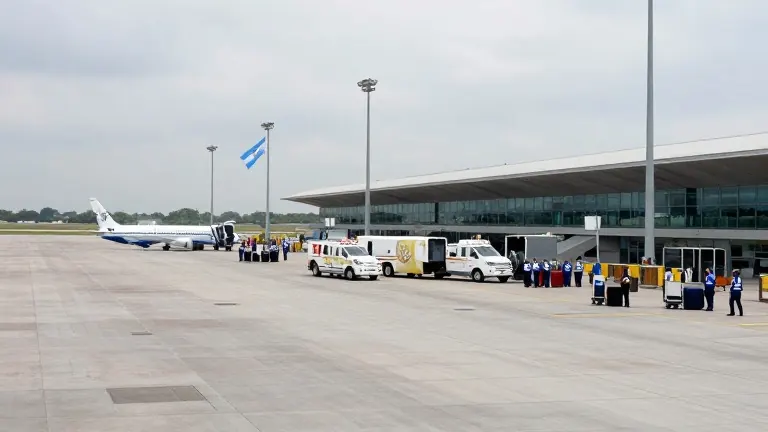
Milei met the Pope at the Buenos Aires airport for a traditional welcome ceremony and exchange of speeches. The two leaders have distinct policy views that may surface during their talks. Milei’s government has promoted limited regulation to attract artificial intelligence investment and data centers. Leo, however, has warned about the threats AI poses to humanity and the environment, calling for strict, internationally policed safeguards on its development.
Leo, 71, has maintained a vigorous schedule throughout the tour. He underwent surgery on October 13 to remove a cancerous tumor from his lung but has appeared in good physical form. He has not cut any events short, including those that extended past midnight Rome time. His energy aims to reinforce his image as a political as well as spiritual leader.
Luis Bahamondes, a professor at the Center for Judaic Studies at the University of Chile, described the visit as a chance to solidify Leo’s role as a widely recognized figure who does not shy away from conflict. "This visit will also serve to reinforce the image of Leo as a leader, not merely in a spiritual sense, but in a much broader capacity as a political leader and a widely recognized figure who, far from shying away from conflict or tension, offers a powerful perspective and commands a highly respected voice," Bahamondes said.
The trip also addresses unfinished business from Pope Francis, who never returned to Argentina during his 12-year pontificate. Francis, the former archbishop of Buenos Aires, was a divisive partisan figure who advocated for marginalized communities. David Lantigua, a theology professor at the University of Notre Dame’s Kellogg Institute, noted that disagreements over Francis’s legacy persist in Argentina. "I think we’ll see that kind of tension with Leo, that’s the ministry Francis left behind," Lantigua said.
Leo spent two decades as a missionary priest in Peru, ministering to poor people. His pastoral style mirrors that of Francis, to whom he owes his pontificate. The trip continues in Peru, Leo’s second homeland, following the events in Argentina and Uruguay.